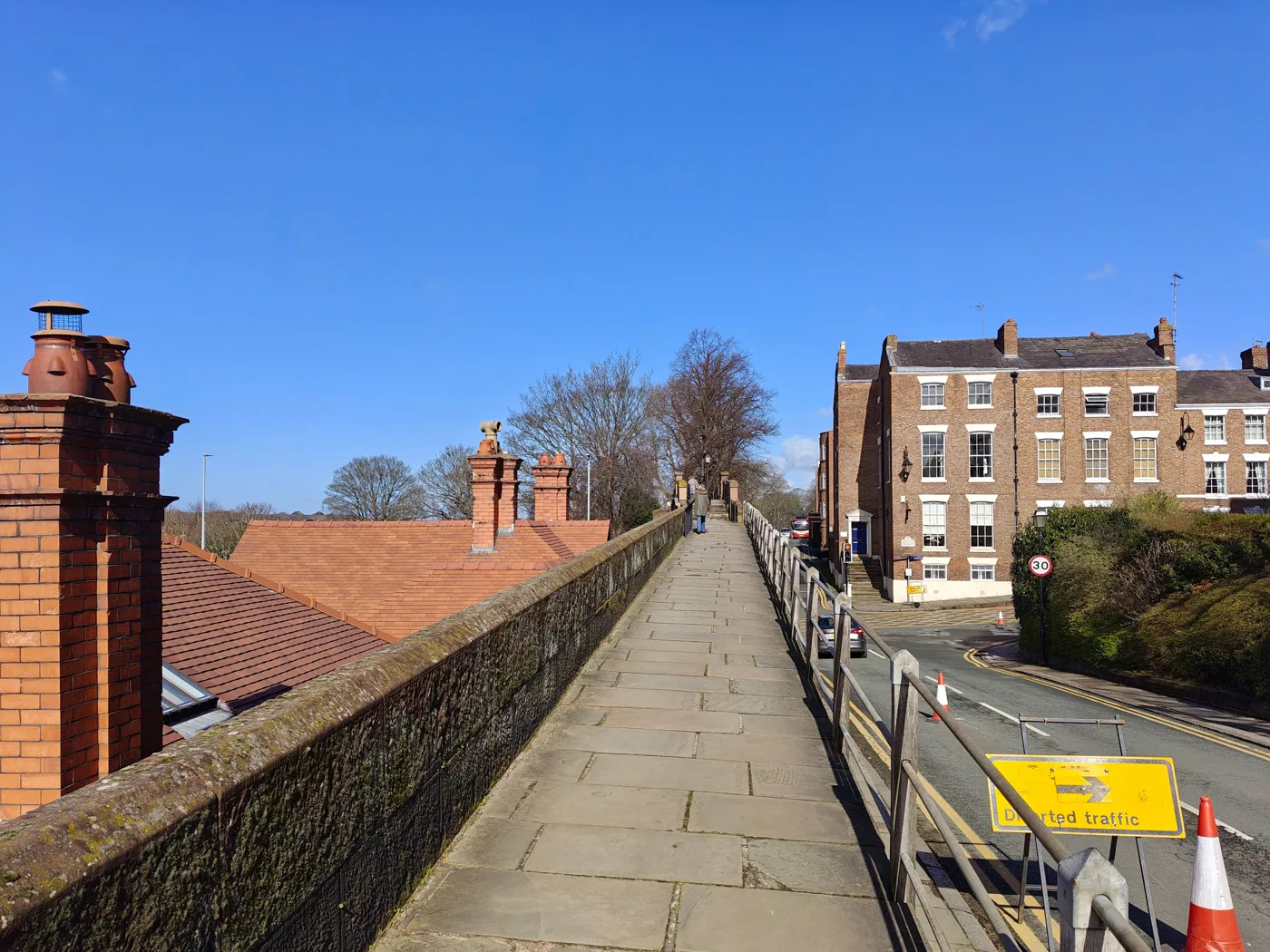

An internal audit found the walls' 113 structures have never had a principal inspection, and that only 11% of the borough's 368 bridges ever have.
Chester’s city walls have never been given a principal or structural inspection, despite being a scheduled ancient monument made up of 113 separate structures. That is the finding of Cheshire West and Chester Council’s own internal auditors, in a report that went before councillors on Monday.
The same audit found that of the borough’s 368 council bridges, nearly half of them more than 100 years old, only 42 have any record of ever receiving a principal inspection. That is 11%. Just 25 of those inspections were done within the last six years, the interval that national best practice sets.
The review, into the management of health and safety on the council’s high-risk assets, was scored “Limited Assurance”, meaning the controls examined do not give adequate assurance. It was published in the papers for the Places Overview and Scrutiny Committee, which considered it on 7 September, after the Audit and Governance Committee referred it there on 17 March 2026.
Auditors were careful about what they were and were not saying. They found Highways staff knowledgeable, “positive and enthusiastic”, clear about the law, and already raising these risks internally. What they could not find was evidence the inspections had been done.
What has and has not been inspected
The benchmark is National Highways’ code of practice, Well Managed Highway Infrastructure. Against it, the audit records:
- Two-yearly visual inspections: consistently carried out on all structures. These have noted the structures deteriorating, with increased rainfall a contributing factor, particularly for those crossing watercourses.
- Principal inspections, a review of physical condition: 42 of 368 bridges have any record of one. In 2023-24 and 2024-25 an average of five a year were completed.
- Structural reviews, evaluating overall integrity, due every 12 years: no records of any, on any bridge.
- Scour assessments, checking what water is doing to foundations, also due every 12 years: no records of any.
- Chester City Walls, 113 structures: never subject to a principal or structural inspection.
- Retaining walls, just over 100 of them under Highways: no evidence of principal inspections or structural reviews.
The audit’s own summary is that this “indicates significant historical non-compliance with best practice inspection standards”, and that there is “a risk of significant hidden liabilities due to a lack of thorough inspections for many years”.
Senior Highways staff told auditors they believe the council’s position is broadly consistent with most other local authorities, though the review could not find comparative data to test that.
Money is the reason, and money is the problem
The blockage was capital budget. Visual inspections are cheap; principal inspections are not. A standard one costs around £10,000 per structure. Complex ones cost far more: the current inspection of the Nicholas Street Viaduct, which carries St Martin’s Way past the walls, has a capital budget of £1.2m because of its post-tensioned design. Inspecting the city walls is likely to be similarly complex and expensive.
Extra funding was secured for 2025-26 and, auditors were told, will continue. It buys 63 principal inspections, including elements of the city walls, 25 structural reviews and 95 scour inspections in the current year. As at January 2026, 21 of the principal inspections and 10 of the scour assessments had been done.
At that rate the council would meet the six-year principal inspection standard on all its bridges. Clearing the backlog of structural reviews would still take 15 years. Highways is developing a proposal to compress principal inspections into three years instead of six, though the audit records it as very early stage with unknown costs.
The bigger financial risk sits behind the inspections. Remedial work found by them is undefined and unbudgeted, and auditors judged it “very likely” that repairs will be needed, with the potential for significant costs that could in turn threaten the inspection programme itself.
Street lights: 15,000 columns overdue, and a £12m bill nobody has funded
The audit examined two other categories of high-risk asset. Street lighting produced the starkest single number.
Mandatory electrical testing of lighting columns is done every six years, in line with the law. Structural testing of the same columns, which best practice says should happen at the same frequency, stopped keeping pace in 2023. Until then both were done together. When Colas took over the highways contract, the company later told the council its staff were not qualified to carry out the structural reviews, despite a rate having been agreed for them.
The consequence: structural reviews fell from an average of just under 7,000 a year, enough to cover the whole stock on a six-year cycle, to about 400 a year in 2023-24 and 2024-25. As at August 2025, roughly 15,000 columns had not had a structural test in six years. A new arrangement with Electrical Testing Ltd covers both tests from 2025-26.
Separately, around 30,000 columns had their lamps replaced between 2015 and 2018. Those lamps have a typical ten-year life. At an average £400 a unit, the audit puts a potential £12m of replacements over the next three years, and there is no replacement plan: lamps are changed when someone reports one out, and there is no system that tells Highways a lamp has failed.
The number failing is already climbing, from 334 in 2023-24 to 424 in 2024-25 and a projected 600 in 2025-26.
A £12m bid went to capital finance colleagues. No additional capital funding was approved. The council used Department for Transport money to lift the street lighting budget from £0.9m to £1.035m, which the audit says does not address the risk. On that basis, auditors write, “it is assumed that management have accepted the associated risks and will manage them within existing resources”.
Trees: the survey status of up to two-thirds is unknown
There is no fixed legal interval for tree surveys, but there is a duty to keep the public safe. Auditors found the Highways Service “cannot currently state with certainty” what proportion of the trees it is responsible for are recorded, surveyed, or need surveying. More than 109,000 trees have been surveyed since August 2023, but the condition and survey status of a significant number, “possibly up to two-thirds”, is unknown.
New mapping software, Treeplotter, came in during August 2025 and should establish the position across the borough over two to three years. A Tree Risk Management Plan with zoning plans is in development.
Responsibility for trees is also split across the council, and the audit found little assurance outside Highways:
- Cemeteries documents its trees and commissions surveys every two years, the one arrangement auditors considered adequate, though staff there lack specialist knowledge to interpret the reports.
- Parking Services holds no information on trees in council car parks and carries out no surveys. Surveys are now being commissioned, and there are more than three times as many trees on car park perimeters as inside them.
- Property holds no information on trees on or beside council land and conducts no surveys.
- Council-maintained schools: no evidence of any central assurance, and no definitive list of the number, condition or survey status of any trees. The health and safety team asks schools about trees during visits, but the audit found nothing is done with the answers.
The Head of Highways and Infrastructure met the Director of Education and Inclusion in November 2025 to discuss it, and an advisory note was agreed for schools.
A further 13 significant bridges, one retaining wall and 26 bridges in parks and countryside sit with Environmental Services rather than Highways. General inspections of the 13 were due this year with no identified budget to commission them. Two principal inspections went ahead on consultants’ advice: one found no work needed, the other identified work required. Environmental Services has no in-house engineering expertise to interpret its consultants’ findings, and a paper has been prepared arguing these bridges should move to Highways.
What it means for you
Nothing in this audit says a bridge, a wall or a lamp column is unsafe. It says the council cannot currently demonstrate that they are, which is a different problem and a slower one.
The practical consequence is legal rather than immediate. Auditors warn that without an agreed strategic position, “should an incident occur which causes harm to individuals or property, the Council may not be in a strong position to defend itself”. That is the same weakness that shows up in the council’s road damage claims, where refusals have fallen from 76% to 55% in three years, covered in our report on Cheshire West’s pothole claims.
If a street light near you is out, report it. The audit is explicit that there is no system telling the council a lamp has failed, so a report from a resident or an operative is the only trigger for a replacement, and failures are rising.
If a tree on council land worries you, report that too. For a third of the council’s services the honest position is that nobody currently holds a record of it.
Seven actions were agreed with managers when the report was finalised in March 2026, for completion by the end of May 2026, with the accelerated three-year bridge inspection programme running beyond that. Two were already complete when the papers were written. Where the Nicholas Street Viaduct inspection has got to is on our Chester roadworks and travel page.
Frequently asked questions
Have Chester’s city walls been inspected?
Visually, yes, as part of the two-yearly inspection of all council structures. The council’s internal audit found that the 113 structures making up the walls have never been subject to a principal inspection, which reviews physical condition, or a structural review. Elements of the walls are included in the 63 principal inspections funded for 2025-26.
How many bridges does Cheshire West and Chester have?
The Highways Service is responsible for 368, nearly half of them over 100 years old, plus just over 100 retaining walls. Environmental Services holds a further 13 significant bridges, one retaining wall and 26 bridges in parks and countryside.
Are Chester’s street lights safe?
The audit does not say they are unsafe. It records that mandatory electrical testing is done every six years in line with the law, but that about 15,000 columns had not had a structural test within six years as at August 2025, which it describes as a breach of generally accepted minimum standards rather than a legal requirement.
Why is the Nicholas Street Viaduct inspection so expensive?
Because of its post-tensioned concrete design, which cannot be assessed from the outside. The council has a capital budget of £1.2m for the work, against roughly £10,000 for a standard principal inspection of a structure.
What is a principal inspection?
A detailed review of a structure’s physical condition, as distinct from the two-yearly visual inspection. National best practice also expects a structural review of overall integrity and a scour assessment of foundations every 12 years. The audit found no record of the council ever carrying out either on its bridges.
Sources
- Summaries of Internal Audit Reports Scored as ‘Limited’ Assurance, Cheshire West and Chester Council, section 1, High Risk Assets: Management of Health and Safety (all inspection counts, costs, street lighting and tree findings, and the quoted conclusions)
- Scrutiny cover report, Highways Claims and Highways Management of High Risks Update, Places Overview and Scrutiny Committee, 7 September 2026
- Places Overview and Scrutiny Committee, 7 September 2026 (full agenda and papers)
- Nicholas Street Viaduct inspection, Cheshire West and Chester Council
Have your say